Ok, a confession. With Fika we learned the hard way that getting users is not the same as having a business. We were growing, mostly thanks to paid campaigns, but we weren’t unique enough for someone to move their whole blog to our platform. An expensive lesson.
Since then I’ve had one idea stuck in my head: in 2026 the expensive part is not building. With AI, building a tool costs a fraction of what it did five years ago. The expensive part is getting attention and traction.
So this time I wanted to do it the other way around. Before building anything, decide which ideas deserve my time. This week I put together a framework for that with Claude, a method with steps and rules that I apply the same way to every idea. The first version looked great. Then I used it for real and it broke in a few places 😅
Here’s how it ended up and what I had to change.
First rule: AI doesn’t validate anything
AI is really good at finding data, comparing competitors and pricing, or spotting the weak points of a plan. But it can’t tell you if someone will pay. And if you ask how big a market is, it gives you a number with scary confidence. Sometimes, made up.
That’s why every market data point needs a source. No source, it gets marked as “not verified” and doesn’t score.
The bar also needs to be specific. Mine is a first paying customer, in a short time and with a fixed budget. A friend saying “great idea” doesn’t count, and neither do likes.
The steps

Quick summary.
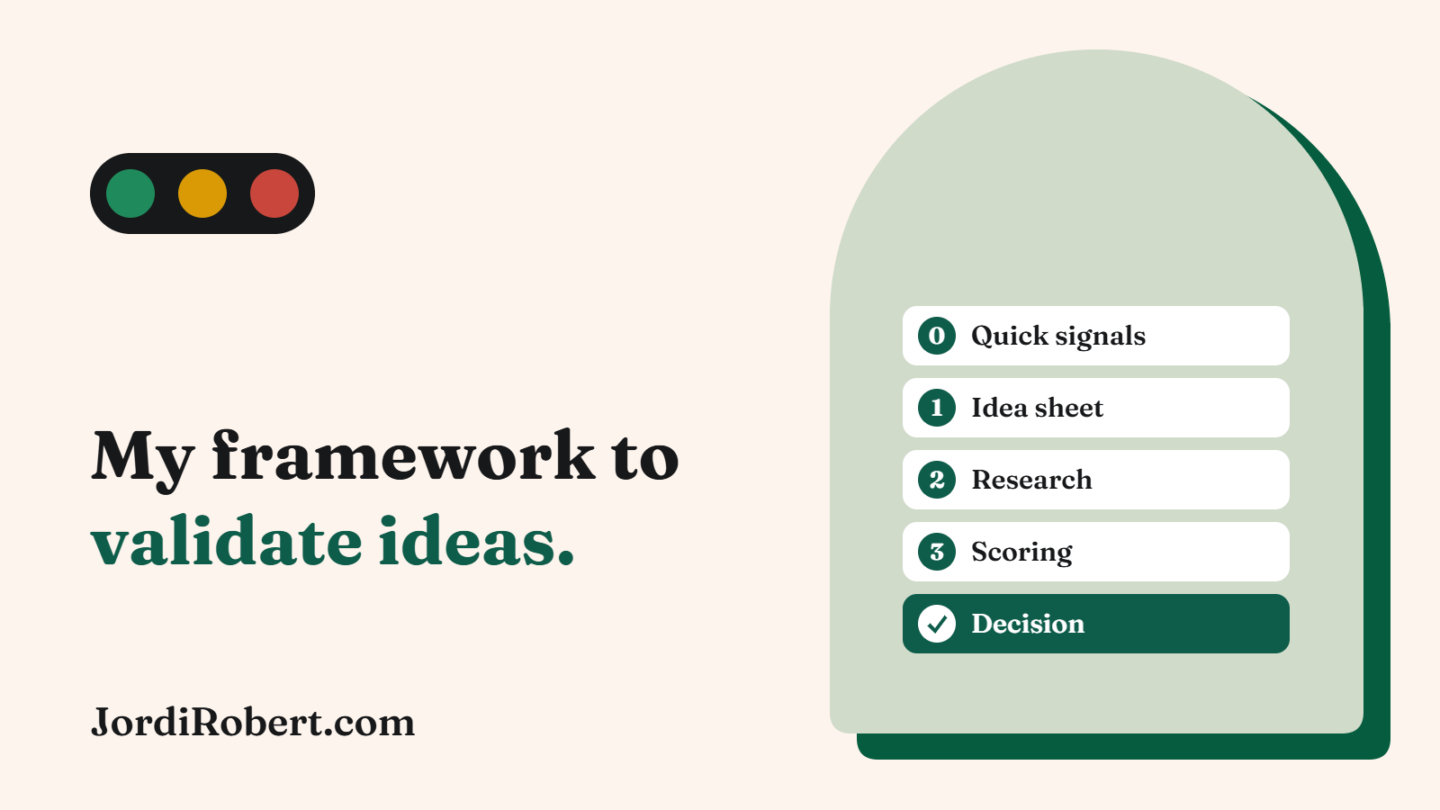
Step 0, quick demand signals. 15 to 30 minutes to rule out what has no chance at all. Further down I explain why this step didn’t exist at first.
Step 1, the idea sheet. I write it myself, by hand and without AI: what it is, who it’s for, what problem it solves, what I’d charge and where the first buyer is. If I let the AI write it, it gives me back my idea looking prettier than it is, and I already do that on my own.
Step 2, research. This is where the AI works, but it only brings sourced facts plus a separate list of what it couldn’t verify. Quite often that list is the most useful part of the report.
Step 3, scoring and pre-mortem. I give the same sheet and the same evidence to Claude and ChatGPT, separately, and ask them to act as skeptical reviewers. I look at where they disagree: if one gives a 4 and the other a 2, there’s an assumption nobody is sure about. Then I ask them for a pre-mortem, which means imagining the project has already failed and explaining why. I use this prompt:
It’s day 30. The project hasn’t got a single paying customer. Write the 5 most likely causes, from most to least likely, and for each one tell me which early signal would have given it away in week 1 or 2.
Whatever both of them repeat is the first thing to measure once you get going. That said, you have to copy and paste between the two AIs by hand, so I keep this step for the ideas that end up close.
And the decision. Four questions say whether the idea makes it to the table, and the one with the highest score is the one I pick. The smoke test, the page with a price and a buy button, comes afterwards, in the first days of the month and with the idea already chosen. Further down I explain why I moved it.
What broke when I used it
Now the interesting part.
Fail 1: everything went through hours of analysis. The first version didn’t have step 0. Every idea went through the sheet, the research and the scoring, when 15 minutes of data would have been enough to rule out many of them. Now that filter goes first.
Fail 2: it counted brand searches as demand. A keyword tool (Semrush, Ubersuggest or DataForSEO if you prefer an API) shows you thousands of searches for a competitor’s name and it looks like there’s a market. But those people are looking for that competitor’s website, not a replacement. The ones that count are “alternative to”, “pricing” or “X vs Y” searches, and there are almost always far fewer of them.
The funny thing is I had already seen this first-hand. At Fika, one of the Google Ads campaigns that worked best was “Alternative to Substack”, generating signups at less than 3–4€ depending on the day. I wrote about it here. And still, the first version of the framework didn’t separate one kind of search from the other.
A tip while we’re at it: check a fixed list of keywords in one go. Related keywords reports burn way more credits and you almost never need them for this.
Fail 3: it only looked at searches. That works in B2B, where whoever has a problem googles it. In B2C, a lot of demand is discovered on social media. A consumer product can have four searches a month and a huge audience on TikTok. So step 0 is now a traffic light per channel:
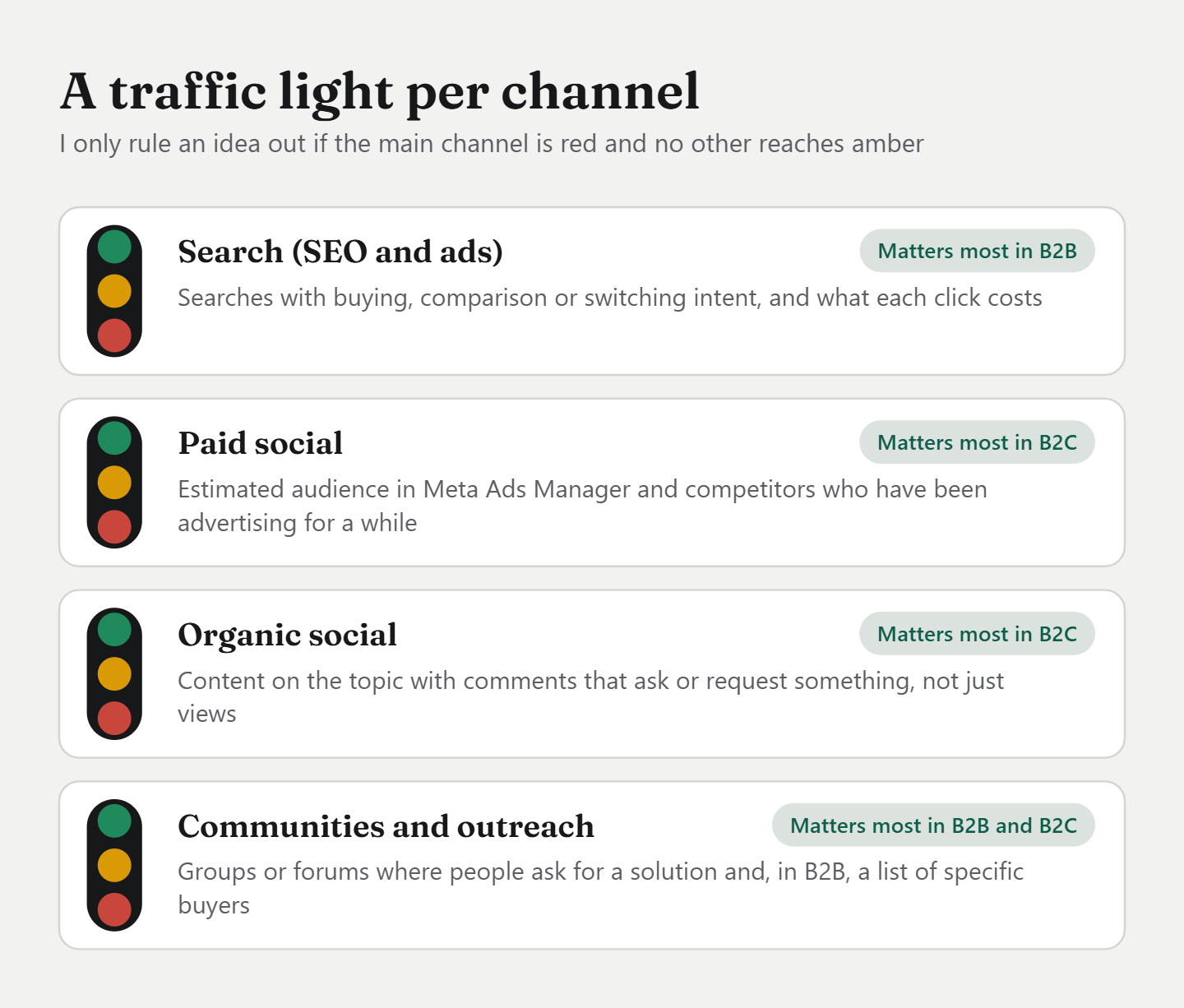
Each channel comes out green, amber or red, and I only rule an idea out if the main channel is red and no other gets to amber. How to set each color is at the end, in the full framework.
Fail 4: ideas without a price. Without a price there’s nothing to validate, so now it’s mandatory. I also want the advantage to fit in a headline (“like what’s out there, but a bit better” doesn’t make anyone switch) and the sheet has to say how much it costs the customer to switch from what they use today. If switching is scary, price matters a lot less than you think. That’s exactly what happened to us with Fika: the product worked, but moving platforms was a lot to ask for how little we stood out.
Fail 5: the smoke test, before choosing. In the first version, every idea had to pass a smoke test before being chosen: a page with the price, a buy button and some money on ads. Sounds good until you have five ideas. Five pages, five campaigns and five budgets to decide something the month itself measures much better, with a real product. So I moved it inside the month: in the first days, while I build, I put up the page with the price and push it through the main channel. I need that page to launch anyway. And if by week 2 there isn’t a single sign of payment, I stop in time.
Motivation, in its own box
In the end I compare ideas across five blocks, from 1 to 5: opportunity, feasibility, promotion, learning and motivation.
Motivation goes on its own on purpose. Of course it matters that you actually want to spend a few weeks on a project, but if I let that leak into the other scores, everything comes out higher than it really is.
I added learning because I want to pick up new skills along the way. So I write down which channel would need to work for the idea to succeed and what skills it requires. A short-form video channel made with AI, for example, needs writing hooks, generating video and voice, editing with templates and automating publishing. If I can’t do it and don’t feel like learning it either, bad sign.
How I decide

If all four come out yes, the idea goes to the scoring table to be compared with the rest.
The full framework
Here it is, in full. Copy it and adapt it to your idea.
1. The idea sheet
Fill it in yourself, without AI. If it doesn’t fit on half a page, the idea isn’t ready yet.
- What it is, in one sentence.
- Who the customer is: a specific profile, not “companies”.
- What problem it solves and how that customer solves it today.
- What you’d charge and how: one-off payment or subscription. This one is mandatory: no price, no going further.
- The minimum you could charge for and build within the time you’ve given yourself.
- Your advantage, in a sentence that fits in a headline.
- How much it costs the customer to switch from what they use today.
- Whether the purchase is decided in a few weeks or takes months.
- Where your first buyer is and how you’ll reach them.
- Whether it’s B2B or B2C, in which market and in which language.
- Why you: what you know or have that others don’t.
- What worries you or what you don’t know yet.
And separately, the channel and the skills:
- Which channel would need to work for the idea to succeed.
- What skills that channel requires.
- Which ones you already have.
- Which ones you’d learn, and whether you feel like learning them.
- What the main risk of that channel is and how you’ll measure it.
2. The traffic light per channel
Before looking at any data, write down for each channel which number puts it in green, amber or red. If you decide afterwards, the data will convince you of whatever you already wanted to believe.
- Search: monthly searches with buying, comparison or switching intent, and what each click costs. Pure brand searches don’t count.
- Paid social: the estimated audience in Meta Ads Manager, and competitors who have been advertising for a while in the Ad Library.
- Organic social: content on the topic with comments from people asking for something or asking questions, not just views.
- Communities and direct outreach: groups or forums where people ask for a solution and, in B2B, whether you can build a list of specific buyers.
You only rule an idea out if the main channel is red and no other gets to amber. For paid channels, also work out the click ceiling: budget divided by cost per click.
3. The prompts
The research one. Give it the idea sheet along with this text:
I’m giving you the sheet for an idea. Research it with web search and a keyword tool, and give me back ONLY sourced facts.

Rules:
1. Every data point comes with its link and the date it was checked.
2. If you can’t find something, write “not verified”. Don’t estimate or fill gaps.
3. Don’t give opinions or scores.

Give me back:
- Volume and trend of the main keywords, in the market and language of the sheet, separating brand searches from buying, comparison or switching searches.
- Between 5 and 10 competitors or alternatives with their visible price.
- Signs that someone already pays: prices, active ads, reviews.
- Where the buyer can be found.
- Rough cost of getting a customer through the channel in the sheet.
- Channel risks: advertising rules, trademarks or legal requirements.
- At the end, the list of key data you could NOT verify.
The scoring one. With the sheet and the evidence:
I’m giving you the sheet for an idea and the evidence gathered. Act as a skeptical reviewer, not a cheerleader.

Score these blocks from 1 to 5 and justify each score in 2 or 3 lines citing the evidence:
1. Opportunity: real demand and people who already pay.
2. Feasibility: whether something chargeable can be built within the sheet’s timeframe.
3. Promotion: whether customers can be reached with the sheet’s timeframe and budget.

Rules:
- A high score requires sourced evidence. Without a source, 2 at most.
- Point out the 3 weakest assumptions in the sheet.
- Tell me which specific data point would change your score.
- Don’t make up market figures.
Give it to two AIs separately and compare. If they’re 2 points or more apart on any block, look into that assumption before moving on.
And the pre-mortem one, also to both:
It’s day 30. The project hasn’t got a single paying customer. Write the 5 most likely causes, from most to least likely, and for each one tell me which early signal would have given it away in week 1 or 2.
4. The scoring table
Each block, from 1 to 5. The total is out of 25.
| Block | What it measures |
|---|---|
| Opportunity | Real demand and people already paying for something similar |
| Feasibility | Whether you can build something chargeable in the time you’ve given yourself |
| Promotion | Whether you can reach customers with your timeframe and budget |
| Learning | The new skills you’re interested in learning |
| Motivation | Whether you feel like spending a few weeks on this |
Before adding up, apply the rule-outs:
- Opportunity below 3: ruled out.
- Promotion below 3: ruled out with that channel. With another one, it starts again as a new idea.
Among the ones left, the highest score wins. If they tie, the one that does best on promotion, because that’s what most decides whether the first customer shows up or not.
5. The smoke test, with the idea already chosen
It comes in the first days of the month, while you build. No separate budget needed: it’s the page you’ll need to launch anyway.
- A one-screen page with the promise, the price in plain sight and a “Buy” or “Book” button.
- A form to count who leaves their email.
- Traffic through the chosen channel: a small ad, direct outreach or a heads-up to your list.
- 48 hours measuring visits, clicks on the button, emails left and replies.
The minimums for each of those numbers get written down before launching. And do the click maths: if the budget only buys a few dozen clicks, the test can only disprove.
6. When to stop and how to improve it
Before starting with the chosen idea, write down which smoke test result in week 2 makes you keep going, which one makes you stop and the most money you’ll spend until then. If you decide with a week already invested, you’ll always find a reason to keep going.
When you close each idea, compare the scores you gave with what really happened. If the AIs scored high and there was no demand, or the other way around, change the thresholds, the questions or the prompts, and save the new version with its date.
This framework isn’t final and doesn’t pretend to be. Every idea that goes through it will change it a bit. In the next chapter I’ll apply it to a real idea, with numbers.
If you have an idea and feel like running it through the framework, or you see something you’d change, send me a message 🙂
And if you liked it, share it and subscribe for more spam del bueno.
Translated into:
- EnglishMy framework to decide if an idea is worth building
- EspañolMi framework para decidir si una idea merece que la construya
- CatalàEl meu framework per decidir si una idea mereix ser construïda
- ItalianoIl mio framework per decidere se un’idea merita di essere costruita
- DeutschMein Framework, um zu entscheiden, ob sich eine Idee lohnt
- PortuguêsO meu framework para decidir se uma ideia merece ser construída
- FrançaisMon framework pour décider si une idée mérite d’être construite


Comments