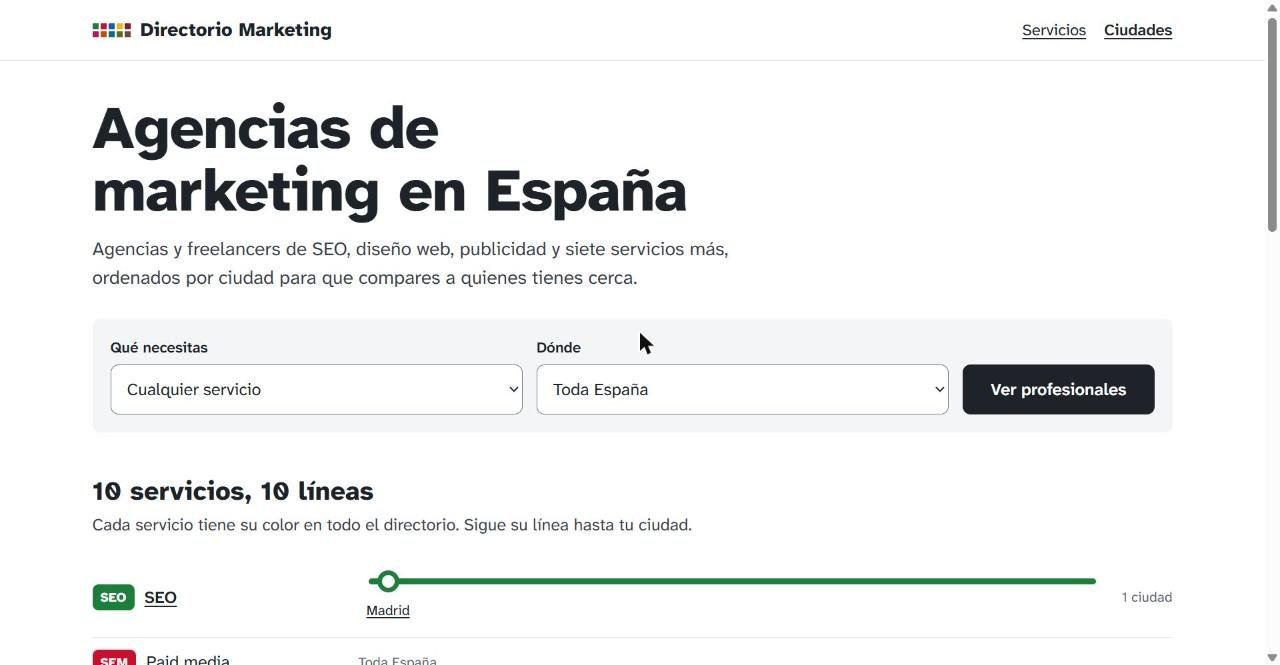
Project DM · directoriomarketing.com, built in public. Here is the series, in order:
- My next project is a marketing directory
- SEO for a directory, from scratch (you are here)
- Forms and leads with no captcha and no cookies (coming soon)
- A 100 on PageSpeed with my own design and no JavaScript (coming soon)
My first project of the month officially kicked off today, 23 November. I started over the weekend. I just couldn’t help it.
The keyword research was done on Friday, and over Saturday and Sunday directoriomarketing.com went from an empty WordPress install to a site with its own design, 243 pages built from that research, and forms. Today it even has a small CRM. I built it with Claude. Cowork plans and checks things in production, Claude Code writes the code and tests everything locally, and I install and decide.
How much have I spent so far? €99, one month of Claude. Not a cent more for now.
There was so much material that I split it into three articles, and I’m starting with SEO, because a directory that doesn’t show up on Google is useless both to people looking for an agency and to the agencies paying to be listed.
Keyword research for 68 cities, in two passes
In the previous article I’d looked at 10 cities and 9 services. Building the site needed a lot more, so the research grew to 68 cities (every Spanish provincial capital, Ceuta, Melilla and 16 big cities that aren’t capitals) and 22 marketing disciplines.
Crossing 22 disciplines with 68 cities, each with its own variants, gives you thousands of combinations, and most of them nobody searches for. So I did it in two passes:
- First pass: all 22 disciplines in the 10 biggest cities.
- Second pass: in the other 58, only the disciplines that had shown demand in the big ones.
If almost nobody in Madrid or Barcelona searches for a growth agency with the city name attached, there’s not much point checking whether anyone in Soria does, so the second pass only looked at what had already proved it had demand in the big cities.
Less noise, less time wasted.
What the keyword research says
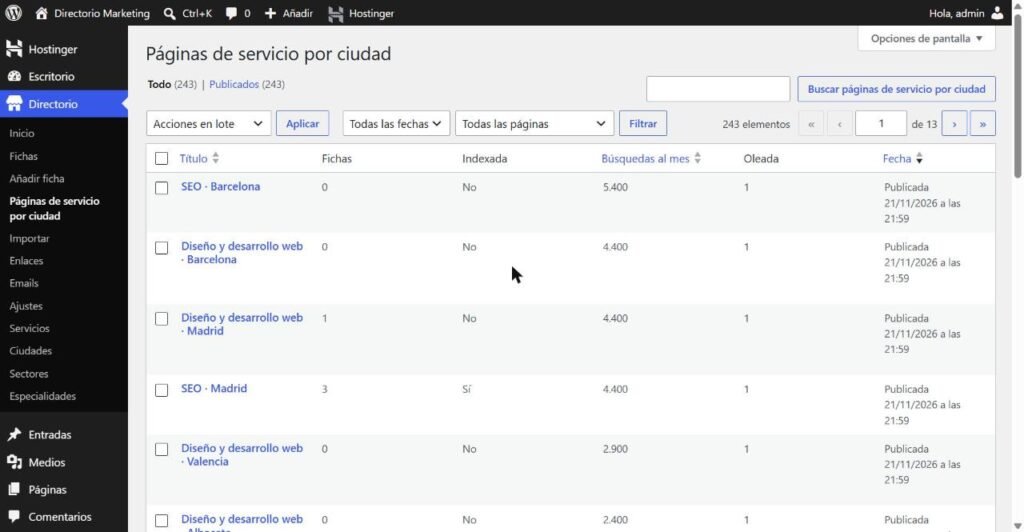
These are the numbers from the keyword research, using search data for Spain as of 23 November 2026:
243
service pages by city
136,700
searches a month across all of them
91%
with a difficulty of 25 or less
77%
of demand is web design and SEO
That 91% figure is what convinced me this can work with a brand-new domain. What I didn’t expect was how concentrated the demand is: web design (56,500 searches) and SEO (49,100) take 77% of it.
The trendy stuff isn’t searched by city. Meta Ads, TikTok and LinkedIn Ads, content, influencers, CRO, analytics, growth and marketing automation barely show up with a city attached, even though they’re the disciplines everyone talks about on LinkedIn. By city, people search for the classics, someone to build their website and someone to get them on Google.
And regions beat their capitals. “Diseño web asturias” (web design Asturias) gets almost twice the searches of “diseño web oviedo”. Oviedo (or Asturias) and Girona have more demand than Murcia or Bilbao, and A Coruña and Tenerife are at the same level.
If you’d asked me before I looked at the data, I’d have got it wrong.
All of this is why the 22 disciplines end up as 10 services.
“Diseño web madrid” and “desarrollo web madrid” (web design and web development) would list the same agencies, and two pages with the same listings are a duplicate page. Meta Ads and TikTok Ads, which nobody searches by city, go under paid media, which is what people search for as “agencia sem”. Before grouping there were 333 service-by-city pages with 100 or more searches a month; after, 243.
The entry keyword
This is my favourite trick from the research.
Take Madrid. “Agencia seo madrid” (SEO agency Madrid) gets 4,400 searches a month and has a difficulty of 27, which is a lot for a newborn website.
And “posicionamiento seo madrid” (SEO ranking Madrid)? 1,600 searches and a difficulty of 14. I call that the entry keyword, because it’s the door a site with no authority yet can get in through, while you work on the main one over time. That’s data from 23 November 2026.
And the date matters. Difficulty gets recalculated. When I started this article the example was Barcelona, with “posicionamiento web barcelona” at a KD of 7, and three days later the very same keyword was at 43.
The idea is for the page to carry both, so it can rank for the hard one over time and for the easy one right away. Here’s the SEO in Madrid listing on Saturday and today:
Saturday, 21 November
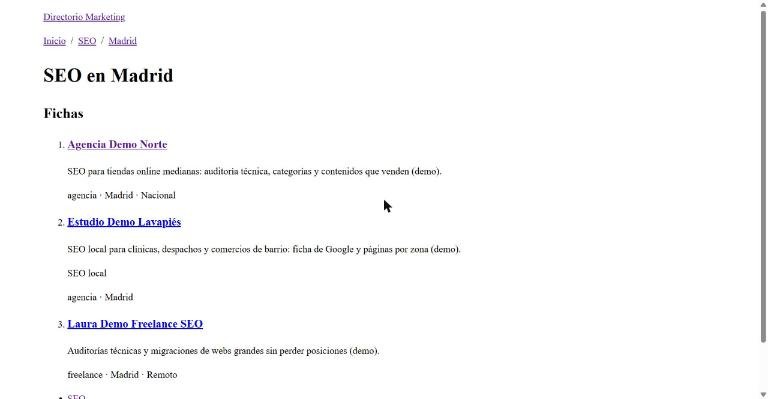
Bare HTML and a three-word H1: “SEO en Madrid”.
Today
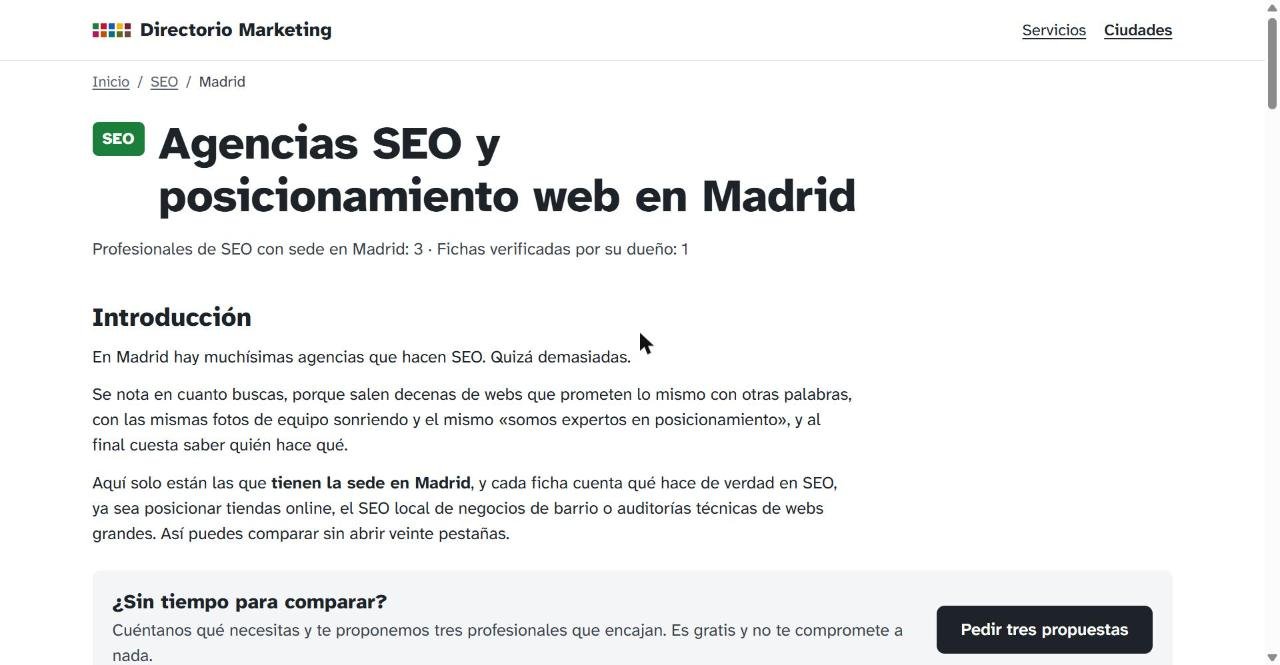
The H1 combines the main keyword and a variant. The listings are demo listings.
/seo/madrid/ or /madrid/seo/?
This one genuinely had me stuck. City first or service first?
So I looked at what the directories already ranking on Google do, using Google’s top 20 for four searches (“agencia seo madrid”, “diseño web sevilla”, “agencia sem valencia” and “agencia de marketing digital barcelona”) on 21 November.
- Sortlist is the only directory in the top 10 for three of the four, and it’s number 1 for “agencia de marketing digital barcelona”.
- Sortlist, Clutch and Habitissimo all put the service first and the city second.
- With the city first, 28 of my 68 cities would have a folder with just 2 pages in it.
I went with service then city (/es/seo/madrid/), but the most useful thing about looking at the competition was understanding what that order is really for. Which pages exist is decided by what people search for in each city, however you build the URL. The order only decides which folder builds up the strength.
Sortlist puts the exact word people search for in the slug (posicionamiento-web, marketing-online). I prefer short slugs, like /seo/, and putting the variants in the title, the H1, the odd H2 and the copy. One detail cheered me up quite a bit: for those four searches, it’s mostly agencies competing, not directories. In other words, there’s room.
The three-listing rule
The big problem with directories is empty pages. You create hundreds of service and city combinations, most of them have nobody in them, and Google sees a site full of pages that add nothing.
All 243 pages were born empty. Every single one.
None of them gets indexed until it has three listings. A page like “SEO en Valencia” with two listings can be visited, but it tells Google not to index it and it stays out of the sitemap. The third listing arrives and in it goes, on its own. That’s one of the reasons for building my own plugin. In the previous article I went through Directorist, HivePress, GeoDirectory and PremiumPress, and none of them has anything like it.
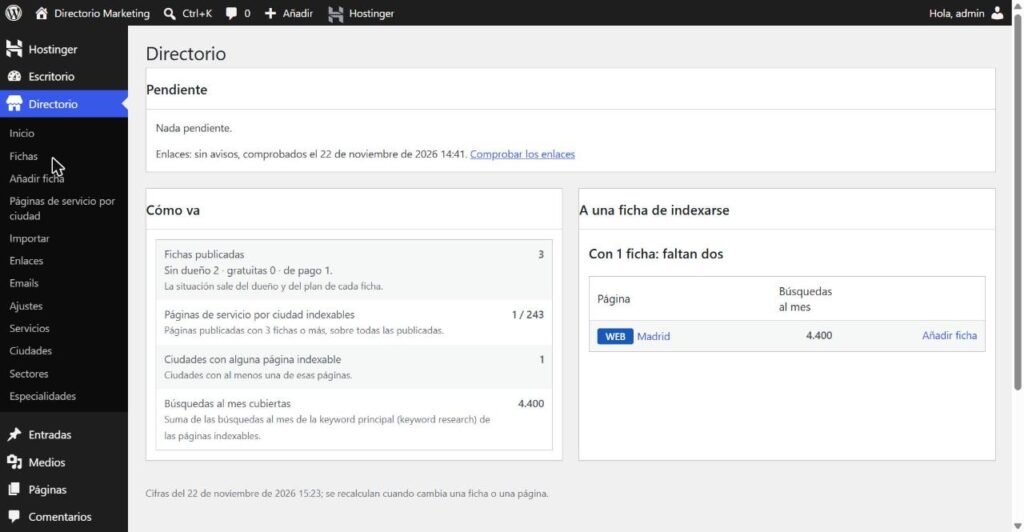
The directory dashboard flips the rule around and turns it into a to-do list.
It has a block called “A una ficha de indexarse” (one listing away from being indexed) with the most-searched pages that are just one listing short of getting into Google, and a button that opens the sign-up form with the service and city already filled in. When I start seeding listings, that will be my priority list.
Unique copy without writing 243 texts
With 243 pages, the temptation is obvious. You write a template, swap the city name and go to bed. Google calls it scaled content abuse. And it penalises it.
We do it the other way round. The copy comes from the real data in the listings. Each listing page has blocks that say how many agencies and freelancers there are, which specialities they cover, who works remotely, in which languages and what their starting prices are, all pulled straight from what the professionals have filled in. Only two listings have that piece of data? Then the block doesn’t show. There are five blocks and each has three ways of phrasing its heading, spread so that the same page always says the same thing on every visit and two different pages don’t sound like carbon copies.
This is how the same listing changed when those blocks were added:
Version 0.4.0
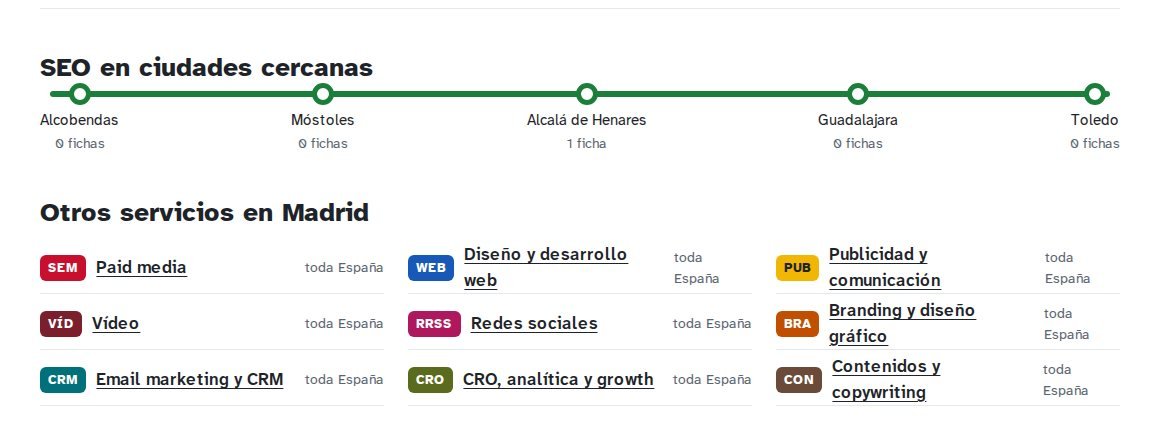
Right below the listings, straight to the nearby cities.
Version 0.4.5
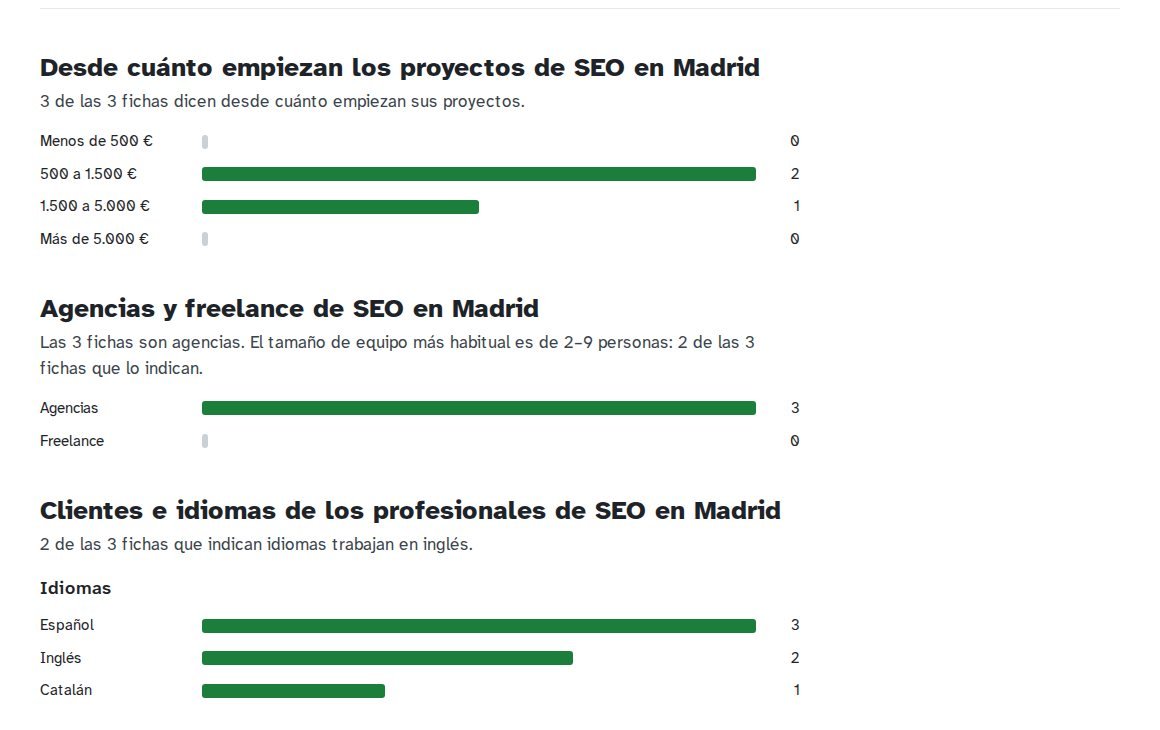
Three blocks built from the listings’ own data, each with its chart.
Internal links with rules
The plugin decides the internal links, following three rules:
- It only links to what Google can index, meaning pages with three or more listings. A page with one listing shows as plain text, not a link.
- No page repeats a link.
- Every block has a limit: 6 nearby cities, 6 services, 4 related lines on each service hub and 12 cities in the footer.
Then there’s a business decision. It matters more to me than the three rules put together. The paid listing doesn’t show “Other agencies” or “Also listed in”.
Anyone landing on that listing has come to contact that agency, and it makes no sense for my site to send them off to the competition. Free listings do carry those blocks, with paid ones first, and I think it’s a good argument for the paid plan, and I haven’t seen many directories that bother with it.
Where it stands and what’s next
There isn’t a single real agency signed up yet. Not a single one.
Everything you see in the screenshots is demo listings. The next step is the professionals’ portal, so that the “you’re already in the directory, claim your listing” email leads to something that works from day one. After that comes seeding the first city with real listings.
In the next chapter I’ll tell you about the forms and leads: antispam with no captcha, knowing where every request comes from without cookies, and why a professional has to accept a request before seeing the client’s details.
How would you have done it? City or service first in the URL? Tell me in the comments.
And if you run an agency or freelance in marketing in Spain, tell me too. I don’t just want to build a listing. I want a network of professionals to learn from each other, make content together (podcast, tutorials) and pass clients along when one of us can’t take them on. I’ll let you know when it opens.
For the developers
If you don’t code, you’ve reached the end. If you do, here’s what’s under the hood.
On jordirobert.com I use Rank Math. Not on the directory. The plugin itself builds the title, meta description, canonical and Open Graph tags, and sets noindex on filtered URLs. The title comes from the stored keywords and combines the main one with the entry one. With the 20 November data, the SEO in Barcelona title was “Agencias SEO en Barcelona · Posicionamiento web”. If the second keyword repeats the first, or the title goes over 60 characters, it gets trimmed. It even restores the accents keywords lose: “diseño grafico” comes out as “Diseño gráfico”.
What if a figure is missing from a text? The copy has placeholders like {{fichas_total}}, and if there’s no number the whole sentence is dropped. I’d rather say nothing than print “0 agencies in Cuenca”.
A curiosity. The directory is also built with AI agents in mind, so it uses the Content-Signal header to say AI can use its content, and the plan was to repeat that line in robots.txt until we found Lighthouse doesn’t recognise it and drops the SEO score from 100 to 92. It stayed in the header only.
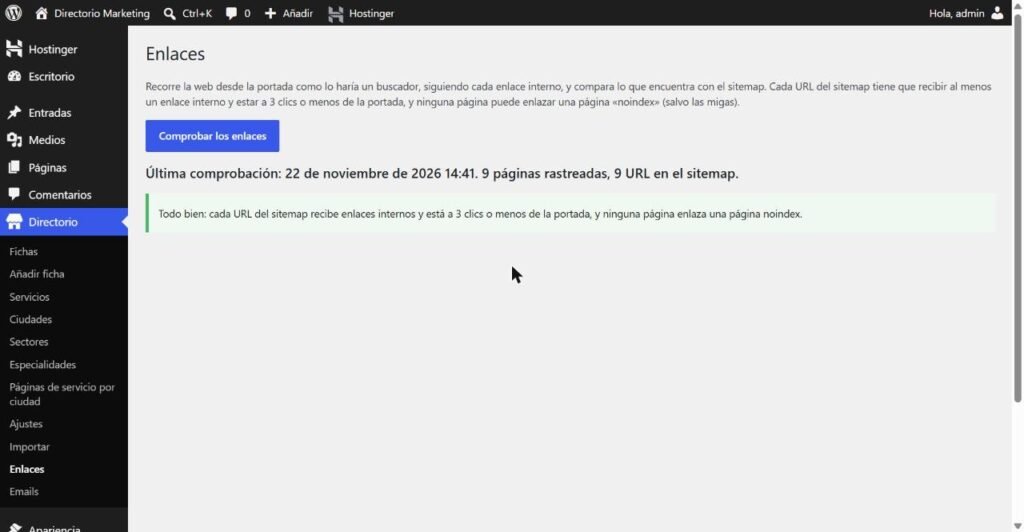
To keep an eye on links there’s a tool in the dashboard that crawls the site from the home page the way a search engine would, counts the clicks and compares the result with the sitemap. On day one, on the test site, it found two orphan listings. They belonged to a city whose page wasn’t indexed yet, so nothing indexable led to them. Now they show on the national service page until their city reaches three listings. In production it found another bug.
And that one taught me a lot more than the first, because the automated tests hadn’t caught it. They checked the link blocks and everything was green, but there was a link to a non-indexed page inside some hand-written copy. The tests were looking at the code. The bug was on the page. Since then, what counts is the page as Google sees it.
Translated into:
- EnglishSEO for a directory, from scratch · Project DM 02
- EspañolEl SEO de un directorio desde cero · Proyecto DM 02
- CatalàEl SEO d’un directori des de zero · Projecte DM 02
- ItalianoLa SEO di un directory da zero · Progetto DM 02
- DeutschSEO für ein Verzeichnis, von Grund auf · Projekt DM 02
- PortuguêsO SEO de um diretório do zero · Projeto DM 02
- FrançaisLe SEO d’un annuaire depuis zéro · Projet DM 02


Comments